
How many days in your life can you say “I met a famous man”? My personal answer is: “not so many”.
Yesterday I had a different thought: how many days in your life, can you say “I met a piece of history”? And my answer is “lesser than the first question”, but… yesterday was one of those days.
The man I’m talking about is probably less famous than Steve Jobs, Nikola Tesla, Alexander Graham Bell or Linus Torvalds, but he has something in common with them: he certainly is a piece of electronic’s history. Why?
His name is Mike Engelhardt and he is the (only) author of LTSpice : “the most accurate, powerful and numerically robust SPICE simulator in the world”, as he described his own software.
My opinion? Giving that I love to use many different simulation tools, such as MATLAB, ANSYS, Scilab, Octave and some python libraries, I can say I have experienced different ways to perform electrical and electronics simulations, but if we focus strictly in the SPICE world, probably Mike is true!
The day in Padua
The day was a seminar date, organized by a semiconductor’s distributor. The focus was on “Switched Mode Power Supply Simulation and stability”.
Mike presented the main topologies (current mode, voltage mode) and for each of them he explained why they use certain solutions and the related stability issues.
He also wanted to underline why LTSPICE beats all other famous SPICE simulators… and I found him very convincing!
It was a pleasant in-depth technical seminar that probably tasted more like a “university class”, than the tasteless marketing of electronic devices that characterizes many other seminars I’ve attended. So unusual seminar, so nice to attend to it!
But during the day, the most important thing is “the man I met”.
The man
Mike is “a life dedicated to SPICE simulation” (for the best analog-electronics company in the planet), but maybe the best thing about him is his “live-performance”.
He started this job back in 1975 and since then he met thousands of people along his road (I’m proud to be one of them). He continues travelling and talking and when you hear at him you immediately feel comfortable (he slowed-down his speech-speed for italian attendees) and you can’t stop listening his words. He always “puts a tale between a mosfet and a control loop”, so you never get bored by him.
He jokes with attendees and many times during the day, there was a nice “laugh-noise”: so strange for an electronics technical seminar.
What I learned
As the seminar started, Mike debuted with this sentence: “I know, I bet that eveyone of you brought a question in this place, and I’m here to try to answer this question”. Well… I had two!
I brought two questions that in 12 years of LTspice use, I had never the opportunity to find an answer, even if I looked in the internet.
Since Mike kindly answered me satisfactionary, I decided to report these answers here for any other user that might have the same questions.
Is it possible to perform thermal simulation with LTspice?
I mean: can I simulate a circuit, taking care of its behavior at the “extreme of its admitted temperature range?”.
Obviously the answer is …YES! With the “.temp” spice directive.
In the following figure, one of my favourite simple circuits: a discrete-component high-side current limiter: 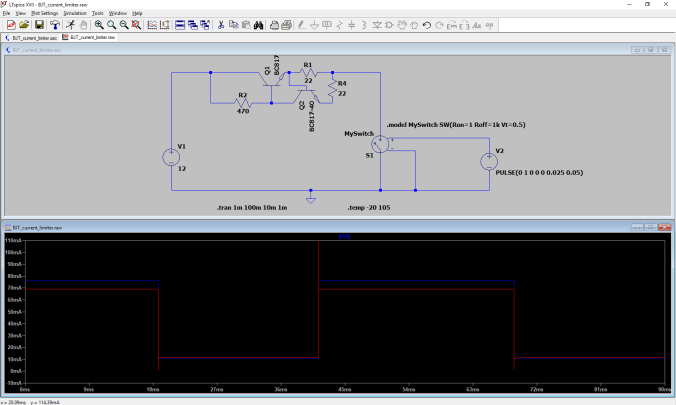
by simply adding the SPICE directive “.temp -20 105” you can appreciate (lower figure) the different current limitation value at -20°C and at 105°C.
I don’t know how useful is this for the most part of LTspice users, but for me it was “quite an epiphany”: thanks to this, now I can very-simply evaluate the impact of temperature in my circuits, without the need of wasting many hours in thermal-controlled chambers!
The second question was:
Does LTspice have support for scripting?
Yes it has! Many times I looked around the web for this answer and finally I had!
How could I be so stupid -I thought- so I never found this info? The answer is that, scripting in LTspice is possible via a SPICE directive named “.measure” (I think that without Mike’s answer I’d had continued browsing the web for several other years…).
By looking in LTspice help you’ll find all the possible commands you could launch in LTspice.
“Measure” can generate a text output such as a CVS file so you can elaborate it via other numerical tools, and the best is: you can generate a test report!
Why am I interested so interested in test reports? Because it’s been a lot of time I was looking for a way to perform unit-test of hardware circuits! Is it a dream? Maybe… but now I have a brand-new tool to try to make it reality!
Summary
As I said at the beginning, I was very glad to know such a “piece of history”. I was 100% satisfied by this meeting and in addition I took home more than I expected: useful informations for my designer’s life!
At the end of the day Mike, talking about the possibility to simulate analog circuits (such as vacuum tubes) with WAV inputs and generate WAV outputs, sentenced something like: “I’d like to be remembered like the man who demystified the ethernal challenge of solid-state against vacuum tube amplifiers”…
Giving that I spent almost five years when I was 25, building and playing my and other’s tube amps, I really think that “the sound is the very-last reason for which people continues preferring vacuum tubes” …but this is another story!
 Dino Spiller
Great article. I will book mark and re-read. I am glad you had such a great time with a great man! I would like to thank Mike for his amazing contribution to our industry.
LikeLike
Thanks david for your comment. Glad to find another Mike’s fan!
LikeLike
Carissimo Dino,
Grazie per questo bell”articolo sul mitico Mike e alcune dritte sulle mille risorse di LTSpice.
Francesco
LikeLike